Home › Middle-school speech therapy games
Middle-school speech therapy games
The hardest part of a middle-school caseload is material that matches the goal without embarrassing the student. Cartoon farm animals do not survive contact with a twelve-year-old, and neither does a worksheet.
These activities target middle-school goals with material a middle-schooler will accept: real photographs, puzzle formats, and tasks with adult content — budgets, routes, schedules.
Who this is for
- Students in roughly grades 6 to 9
- Vocabulary depth, figurative and context-dependent meaning
- Comprehension at paragraph and passage level, including summarising
- Executive function goals: planning, prioritising, self-monitoring
- Students who resist anything that looks like it was made for little kids
Goals these target
- Infer the meaning of an unfamiliar word from context and justify the inference
- State the main idea of a passage and distinguish it from a supporting detail
- Produce a concise summary of a passage in one to two sentences
- Categorise words by shared feature, including non-obvious groupings
- Plan a multi-step task and adjust the plan when a constraint changes
The games

Common Threads
Find the four hidden groups among sixteen words. The format is familiar from the puzzle games students already play, and the categorisation is genuinely hard. 45 puzzles, one or two players.
Open Common Threads →
Context Clues
Unfamiliar vocabulary inside a sentence that supports it — the exact skill their reading assignments demand.
Open Context Clues →
Advanced Word Photo Game
Hard vocabulary with 67 real photographs rather than cartoons, with category and function clues available. The photographs are what make it usable with this age group.
Open Advanced Word Photo Game →
Main Idea Stories Free
Free. The grade 5 band adds a summary question on top of main idea, which is the harder and more useful skill.
Open Main Idea Stories →
Word Explorer — Grade 5
Tier-two vocabulary with pictures, for students who need the words their textbooks assume they have.
Open Word Explorer — Grade 5 →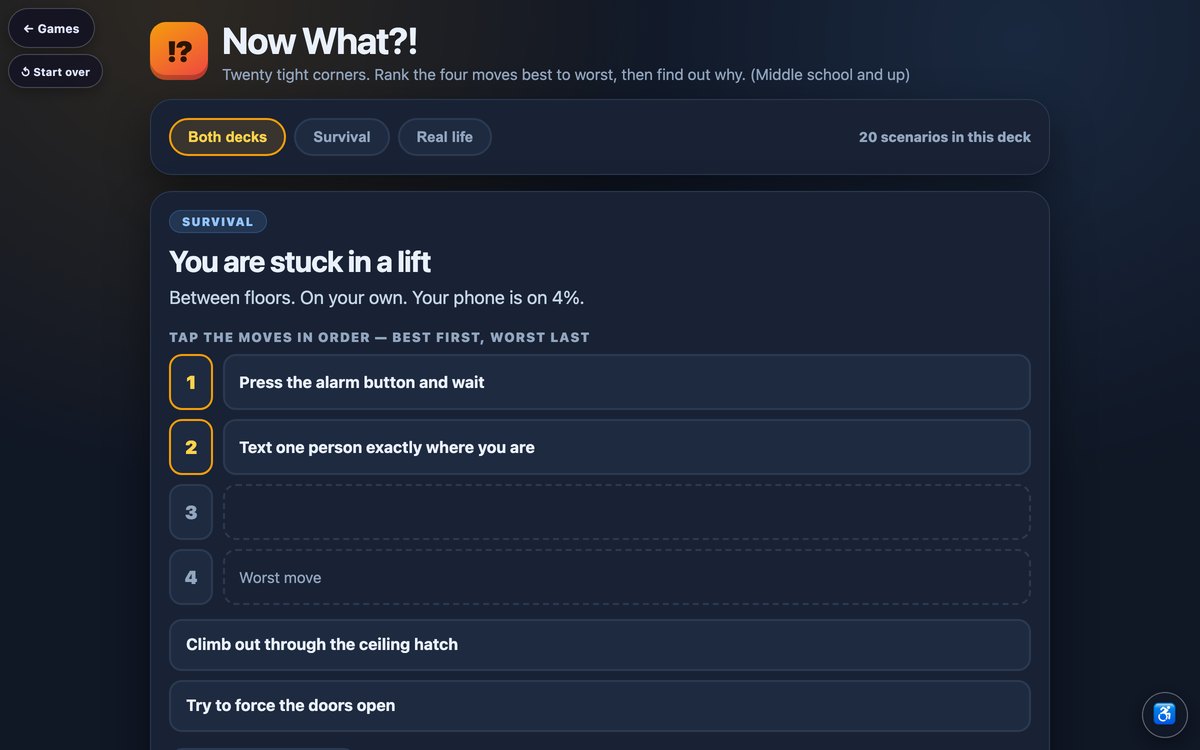
Now What?!
Sixty tight corners — a stuck lift, a rip current, a project partner who has done nothing. Rank four responses best to worst, then see the expert order with a reason attached to every move. The reasons are what makes students argue, which is the point.
Open Now What?! →
Budget Builder
Executive function with adult content: allocate money against competing demands. Plays as a real problem rather than a therapy task.
Open Budget Builder →
Route Planner
Plan a route under constraints, then re-plan when one changes. Good for flexibility goals and for students who insist they are 'fine at planning'.
Open Route Planner →
Pack the Bag
Prioritising against a limit — what actually matters for this trip. Short, and it exposes impulsive choosing quickly.
Open Pack the Bag →Running the session
- Say what the goal isMiddle-schoolers cooperate far better when they know why they are doing something. 'This is about working out a word you don't know from the sentence around it' is enough.
- Two-player where you canCommon Threads and the quiz formats work as competition. A student who will not do a worksheet will often beat you at a puzzle.
- Use their contentWhere a game allows custom words, put in vocabulary from their actual class. The transfer argument writes itself.
- Let them lose sometimesIf you are playing against them, do not throw it. Adolescents notice, and the task stops being real.
- Keep data out of sightScore in your head or on the CSV afterwards. Visible tracking of accuracy tends to shut this age group down.
Questions
Will these look babyish to a teenager?
The games listed here were chosen to avoid it: photograph-based vocabulary, puzzle formats, and executive-function tasks with adult content. Not every game on the site suits this age group, which is why this list is short.
Do they cover written language goals?
Indirectly. Main idea, summary and context clues are the language skills underneath reading comprehension, but these are spoken tasks — the student answers aloud.
Can I use them with a group?
Common Threads has a two-player mode, and the quiz formats work with three or four. The executive-function tasks are better one to one.
Is there anything for social communication?
The inferencing and describing activities carry part of it — reading a situation, giving a listener enough information. There is no dedicated social-skills curriculum here.
Related activities
Built and used by a practicing speech-language pathologist. Nothing here records audio or collects information about a child — see the privacy notice. Games run in any modern browser on a tablet or computer.